

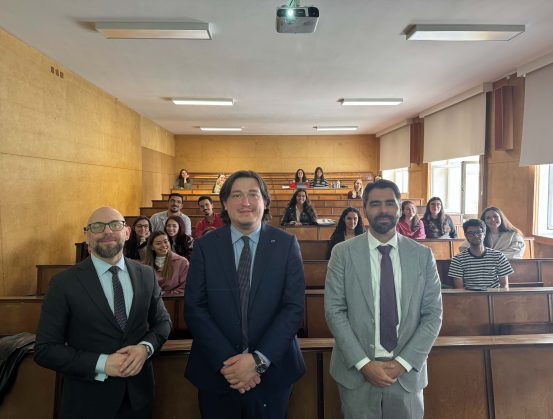
Bartłomiej Oręziak, PhD, Assistant Professor at the Department of Criminal Procedure at the Faculty of Law and Administration of Cardinal Stefan Wyszynski University in Warsaw (UKSW), and PHD, DSc. Marcin Wielec, University Professor, Vice-Dean for Education and Student Affairs, delivered a series of lectures at the Universidade de Coimbra.
The visit of the UKSW academics, carried out within the framework of the Erasmus+ Programme, provided an opportunity to present students with current issues and challenges of contemporary criminal procedure.
The lectures delivered by Bartłomiej Oręziak, PhD focused on an in-depth analysis of procedural aspects of criminal proceedings concerning cybercrime related to telemedicine services. The course addressed the specific nature of offences committed in digital environments where medical services are provided through information and communication technologies. Particular attention was devoted to issues concerning the identification and preservation of electronically processed medical data, the assessment of its integrity and reliability, and the use of digital evidence in criminal court proceedings. The lectures also examined selected categories of telemedicine-related cybercrime, including unauthorized access to medical records, manipulation of patient data, and abuses connected with the remote provision of healthcare services. An important component of the course consisted of case studies and analytical exercises aimed at developing students’ practical skills in evaluating electronic evidence and reconstructing the course of criminal events.
The lectures conducted by Marcin Wielec, PhD , addressed contemporary models of criminal procedure and their future development in the context of rapid technological transformation. The course examined the impact of digitalization, automation, and the increasing use of digital data on criminal proceedings, as well as on the functioning of law enforcement authorities and courts. Particular emphasis was placed on the application of artificial intelligence in criminal proceedings, including its potential role in decision-making processes, the risks associated with algorithmic decision-making, and issues of accountability and transparency in the use of technological tools. The lectures also explored questions related to digital evidence, its reliability and vulnerability to manipulation, as well as the influence of modern image and audio processing technologies on evidentiary practice. Furthermore, the course addressed the protection of human rights and procedural safeguards in the digital environment, including the right to privacy, the transparency of procedural authorities’ actions, and guarantees of a fair trial.
The visit constituted an important element of the internationalization strategy of the Faculty of Law and Administration at UKSW and contributed to the exchange of academic experience in the field of criminal procedural law, particularly in relation to the challenges arising from the development of new technologies.

 10 June 2026


